
Your 2026 soda ash procurement plan is probably outdated. Here’s why.
As North American manufacturing sectors adjust to shifting macroeconomic realities, raw material optimization remains a top priority for procurement executives. Among the core alkalis driving modern industry, Light Soda Ash (Light Na2CO3, CAS 497-19-8) stands out as a critical compound for formulation-heavy sectors, including commercial detergent manufacturing, industrial water treatment, and specialty chemical synthesis.
Unlike Dense Soda Ash—which primarily feeds the massive bulk glass furnaces across the United States—the light grade demands a more nuanced understanding of chemical kinetics, handling logistics, and international sourcing dynamics. This technical insight paper analyzes the core properties of Light Sodium Carbonate and evaluates the strategic layout of its global supply chains.
1. The Technical Anatomy of Light Na2CO3 vs. Dense Grade
From a strict chemical standpoint, Light and Dense Soda Ash are identical molecules (Na2CO3). However, from an industrial engineering perspective, their physical profiles create entirely different operational workflows.
| Technical Parameter | Light Soda Ash Specification | Dense Soda Ash Comparison |
|---|---|---|
| CAS Registry Number | 497-19-8 | 497-19-8 |
| Physical Appearance | Fine, white crystalline powder | Uniform, white granular crystals |
| Bulk Density | 0.50 – 0.6 g/cm³ | 1.0 – 1.2 g/cm³ |
| Dissolution Speed | Exceptionally Rapid | Moderate / Progressive |
For plant engineers, bulk density is the decisive factor. Light Soda Ash features a significantly larger specific surface area per unit of mass. When introduced to aqueous environments, this structural openness facilitates immediate hydration and rapid dissolution.
Key Operational Insight: Processes requiring automated blending or instantaneous chemical reactions rely heavily on the fine powder format of Light Na2CO3 to maintain optimal throughput without the risk of sediment accumulation or equipment downtime.
2. Key Demand Drivers in the American Industrial Landscape
The operational value of Light Sodium Carbonate is highly visible across several critical supply chains in the Americas:
- Surfactant and Detergent Formulations: In the home care and industrial cleaning sectors, Light Na2CO3 serves as a primary builder. It effectively sequesters calcium and magnesium ions in hard water, preventing them from interfering with active surfactants and optimizing overall washing efficiency.
- Water Treatment and pH Standardization: For both municipal water systems and industrial wastewater facilities, the compound serves as an efficient, predictable neutralizing agent. Its high solubility ensures it integrates seamlessly into automated liquid dosing systems without causing mechanical clogs or line blockages.
- Downstream Chemical Synthesis: The light grade acts as a highly reactive sodium source for the synthesis of advanced chemical derivatives, including sodium silicates, sodium phosphates, and specialized chemical intermediates.
3. Global Sourcing Analysis: The Role of the Asia-Pacific Supply Chain
While the United States possesses substantial natural trona deposits, global industrial demand increasingly requires a diversified, resilient sourcing model. In the global matrix, partnering with a primary China soda ash manufacturer or a dedicated soda ash supplier in China has evolved from a simple cost-saving measure into a vital risk-mitigation strategy.
The synthetic soda ash sector—heavily concentrated in the Asia-Pacific region—provides two essential structural benefits to Western buyers:
- Capacity Redundancy: Large-scale synthetic ammonia-soda plants operate outside regional logistical bottlenecks (such as domestic US rail congestion or weather-related mining disruptions), offering an independent layer of supply security.
- Batch Uniformity: Modern, highly automated synthetic production methods yield exceptional chemical purity with negligible trace metal contamination, aligning strictly with the strict quality standards required by premium chemical compounders.
4. Mitigating Maritime Freight Risks: The Science of Moisture Control
For transpacific bulk shipments bound for major American entry hubs like the Ports of Los Angeles, Houston, or New York, the primary operational challenge is hygroscopic caking. Because Light Soda Ash is inherently a fine powder, prolonged exposure to ambient humidity during ocean transit can cause the material to absorb moisture, leading to severe clumping or “bricking.”
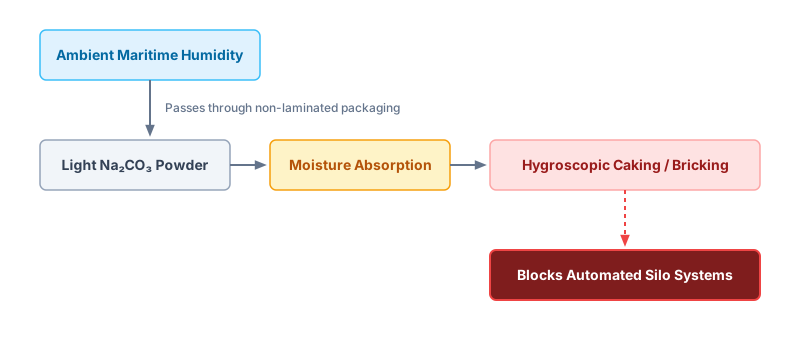
To safeguard the material’s free-flowing characteristics for automated siloing, top-tier soda ash manufacturers in China employ advanced packaging configurations:
- Laminated Barrier Protection: Utilizing multi-layer, moisture-proof laminated PE/PP woven bags for standard 25 kg packaging to isolate the powder from sea-transit humidity.
- Reinforced Bulk Storage: Deploying 1-ton jumbo bags equipped with heavy-duty internal suspended liners that absorb structural stress and prevent moisture ingress.
- IMDG-Compliant Cargo Isolation: Ensuring containers are securely stowed away from acidic materials and temperature-volatile zones aboard vessels to preserve physical consistency upon arrival.
5. Compliance and Document Benchmarking for US Imports
To ensure frictionless customs clearance and maintain compliance with standard corporate audit structures, procurement teams must verify that their overseas partners provide comprehensive, up-to-date technical documentation.
| Procurement Checklist: Minimum Required Documentation | |
|---|---|
| Batch-Specific Certificate of Analysis (COA) | Verifying total alkali content (Na2CO3 ≥ 99%), chloride presence, and exact bulk density. |
| OSHA-Compliant Hazard Communication | Fully updated Material Safety Data Sheets (MSDS) tailored to local North American standards. |
| Third-Party Inspection Cooperation | Fully open to and supportive of independent third-party testing (such as SGS or Intertek) upon buyer’s request to validate volume and packaging integrity prior to loading. |
Actionable Next Steps for Procurement Teams
Navigating the complexities of the 2026 industrial alkali market requires a balance of technical precision and supply chain agility. If your organization is currently auditing its chemical supply dependencies or optimization strategies for the upcoming quarters, cross-referencing your exact manufacturing requirements with verified batch parameters is the most effective way to eliminate operational risk.
To assist your engineering and procurement teams with benchmarking, we offer the following technical documentation support:
- Review Product Specifications: Access exact particle size distributions and purity standards directly on our framework.
- Order a Laboratory Sample: Evaluate batch purity and dissolution speeds directly within your facility.
- Review Logistics Frameworks: Request a targeted freight and packaging quotation for major US destination ports.
Use the technical inquiry form on our Contact page to connect with our logistics team and coordinate your documentation package. Detailed product specifications for Light and Dense grades are available on the Products page.